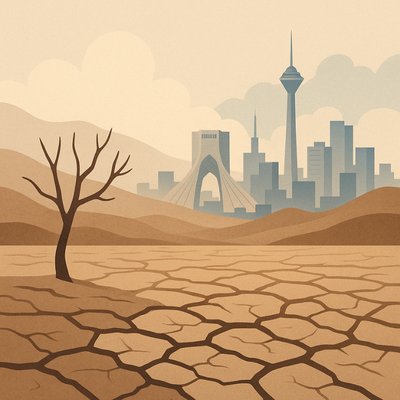
🌧️ Iran saw a 40% drop in rainfall, with some provinces down over 75%.
💧 Ten provinces reported dam levels below 10%, and some reservoirs ran completely dry.
🏙️ Tehran declared a public holiday to curb water use amid severe shortages.
🌍 Groundwater depletion hit 29 cm/year, triggering land subsidence and infrastructure damage.
🚶 Villages are emptying as drought forces rural families to migrate to cities.
Context: A Drought That Never Ends
Iran has now entered its fifth consecutive year of drought as of mid‑2025. National rainfall during the 2024–25 water year fell by approximately 40 % compared to long‑term averages. Some provinces fared far worse—Hormozgan saw a 77 % drop and Sistan‑Baluchestan around 72 %, leaving nearly every region water‑stressed. Only Mazandaran defied the trend with a modest +2 % increase. ncr-iran.org+2
Reservoir Collapse and Impending Urban Day‑Zero
By summer 2025, seven major dams nationwide were below 10 % capacity, and two in the south were already dry. Around Tehran, crucial reservoirs like Amir Kabir, Lar, Latian and Mamloo dropped by over 30–58 % year‑on‑year. Officials warned that the capital could reach “Day Zero” within a month.
In response, the government declared a public holiday in Tehran and 10 provinces on 23 July 2025 to conserve water and electricity. Citizens were urged to reduce water usage by 20 %, with high‑consumption households facing 12‑hour rationing enforcement.
Groundwater Depletion & Infrastructure Collapse
Beyond surface water, Iran’s aquifers are shrinking rapidly. GRACE satellite data reveals an average groundwater loss of 29 cm per year. The consequences are evident: parts of Tehran are sinking as much as 31 cm annually, causing cracks in railways, dams, roads and even at UNESCO heritage sites such as Persepolis. Experts warn these trends may be irreversible without urgent water policy reform.
Socio‑Economic Fallout
Agricultural provinces like Khuzestan, Isfahan and Sistan are witnessing irrigation collapse, livestock losses, and large‑scale migration. One study estimates over 70 % of villages at risk of abandonment. Urban migration is straining cities already coping with electricity cuts, inflation and poor public services. Wikipedia
Food prices have surged as agricultural output falls—rice, wheat and staple availability is impacted. Analysts call for irrigation modernization, crop diversification, and subsidies to support sustainable agriculture.
Government Response & Long‑Term Prospects
Authorities have launched projects like the Sea-of-Oman desalination pipeline to supply eastern cities and extended wastewater recycling in Tehran. Ambitious targets aim to cut agricultural and industrial water use by 45 billion m³/year by 2032, though progress remains hampered by financial sanctions and institutional constraints.
Critics argue that the crisis is self‑inflicted—driven by decades of mismanagement, over‑ambitious dam building, and failure to regulate groundwater abstractions. The situation now risks becoming a political crisis, as public trust erodes amid service failures and protests.