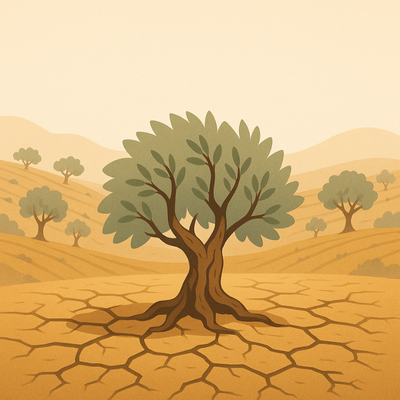
🌿 Italy’s olive harvest has fallen by up to 50% in key regions
🌡️ Persistent drought and extreme heat are stressing ancient groves
🫒 Spain and Greece also report sharp declines in yield
💸 Prices of olive oil and related products have reached record highs
🌍 Europe’s olive belt faces systemic risks from water scarcity
Italy, once the proud cradle of Mediterranean olive oil, is facing a harvest crisis. In 2024, prolonged droughts, extreme summer heat, and dwindling groundwater have devastated the country’s olive yields—particularly in Apulia, Calabria, and Sicily. Farmers report losses of 30% to 50% compared to average years. What was once a climate-resilient crop is now on the frontline of a warming Europe.
Dry trees, bitter fruits
The Italian farmers’ union Coldiretti has warned that traditional rainfed olive groves are suffering from water stress at levels not seen in decades. Despite investments in drip irrigation and water-saving technologies, many producers—especially smallholders—rely on increasingly unreliable rainfall. The Italian National Research Council (CNR) reported soil moisture levels in southern regions during August 2024 were 40% below seasonal norms.
Olives are hardy, but even they have their limits. High temperatures during flowering and fruit set reduce pollination success. Lack of water shrinks the size and oil content of the fruit. In some areas, harvests have been abandoned altogether due to uneconomical yields.
Not just Italy
Spain, the world’s largest producer of olives, has fared little better. After record-low harvests in 2022 and 2023, Andalusia saw another severe drop in output in 2024, driven by a third consecutive year of drought. The Spanish Ministry of Agriculture confirmed a 34% year-on-year reduction in national olive oil production.
Greece, too, reported significant losses, particularly in Crete and the Peloponnese. Portugal’s Alentejo region, though slightly less affected, also saw stress on young groves. Together, these countries represent over 90% of EU olive oil production.
The price of scarcity
Consumers are feeling the squeeze. The International Olive Council noted that wholesale prices for extra virgin olive oil rose by over 80% between January 2023 and May 2025, reaching €9.20 per kilogram in some markets. Supermarket shelves now list 500ml bottles at double the price of just two years ago. Related products—like tapenades, cosmetics, and even luxury soaps—are following suit.
Some producers are resorting to blending or importing cheaper oils to keep costs down, raising questions about quality and transparency. Others are accelerating investments in irrigation and switching to drought-tolerant olive cultivars. But such changes require capital—and time.
A fragile future
Europe’s olive belt is both iconic and vulnerable. For centuries, it has shaped culture, cuisine, and economies. But climate volatility is making traditional olive cultivation increasingly risky. Policymakers face difficult choices: invest in adaptive farming and water infrastructure, or see key agricultural regions decline.
For now, the old olive trees stand—but their future may depend on more than just the Mediterranean sun.