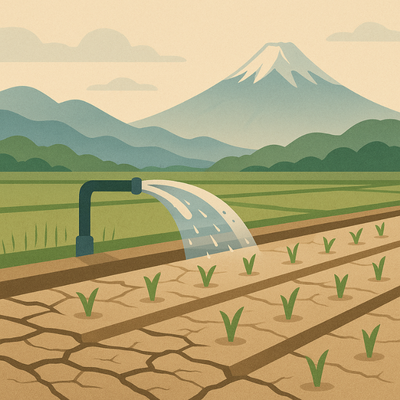
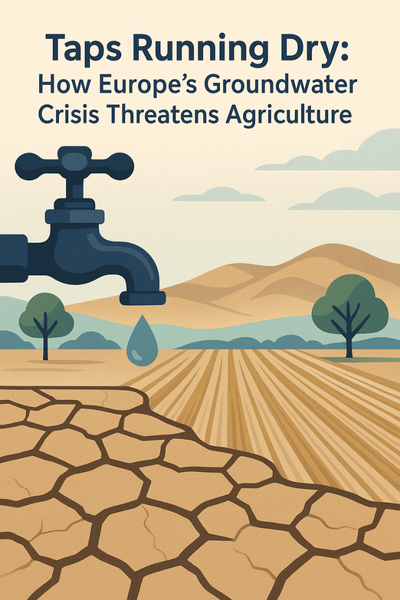
Across the European continent, groundwater reserves—long considered a stable and invisible lifeline—are quietly disappearing. From the plains of northern Italy to the vineyards of southern France and the cereal belts of eastern Germany, wells are drying faster than they can recover. The consequences are severe, especially for agriculture, which accounts for more than 50% of groundwater extraction in many regions.
Vanishing reserves
Data from the GRACE-FO satellites, which monitor changes in Earth’s gravity to infer water storage shifts, show a clear downward trend in groundwater levels over the past two decades. In some basins, such as the Po Valley and the Guadalquivir, storage has declined by more than 15% since 2002. Local measurements, too, tell a stark story: according to Germany’s BfG, groundwater levels in parts of Saxony-Anhalt have hit record lows for three consecutive years.
This depletion is not just due to climate change. Reduced rainfall and higher evaporation certainly play a role, but intensified irrigation, especially during dry summers, is accelerating the drawdown. In France, emergency pumping restrictions were introduced in 2022 and 2023, yet aquifer recovery remained limited over winter. In the Netherlands, officials noted that the recharge period was “insufficient” to make up for deficits accumulated since 2018.
Fields under pressure
The implications for agriculture are profound. Crop yields increasingly hinge on reliable irrigation, yet farmers are competing for a shrinking resource. During the 2022 drought, maize production in the EU dropped 20% below average. In Spain’s Andalusia, olive producers left nearly 200,000 hectares fallow due to lack of water. The European Commission estimates annual irrigation demand could rise by 25% by 2050—even as supply becomes more erratic.
Some regions are adapting. Danish farmers have started switching to less water-intensive crops. In Italy, new precision irrigation systems are being trialed with satellite data inputs to reduce overuse. Yet these innovations remain fragmented, and comprehensive basin-level management is still the exception, not the rule.
Time to rethink policy
Groundwater management in Europe is governed by the EU Water Framework Directive, which calls for “good status” in all water bodies by 2027. Yet over a third of monitored aquifers are currently in poor chemical or quantitative condition. Enforcement remains patchy, and agricultural subsidies still often favour high-consumption crops like corn and sugar beet.
A shift in mindset is needed. As Europe faces more frequent droughts, policymakers must treat groundwater as a strategic asset—not an invisible buffer. That means smarter pricing, stricter enforcement, and better data sharing. Satellites and sensors can now provide near real-time insights. It’s time these tools guide decision-making before the continent’s most vital reserves run dry.